
A pair of Irish George II walnut side chairs

A pair of Irish George II walnut side chairs
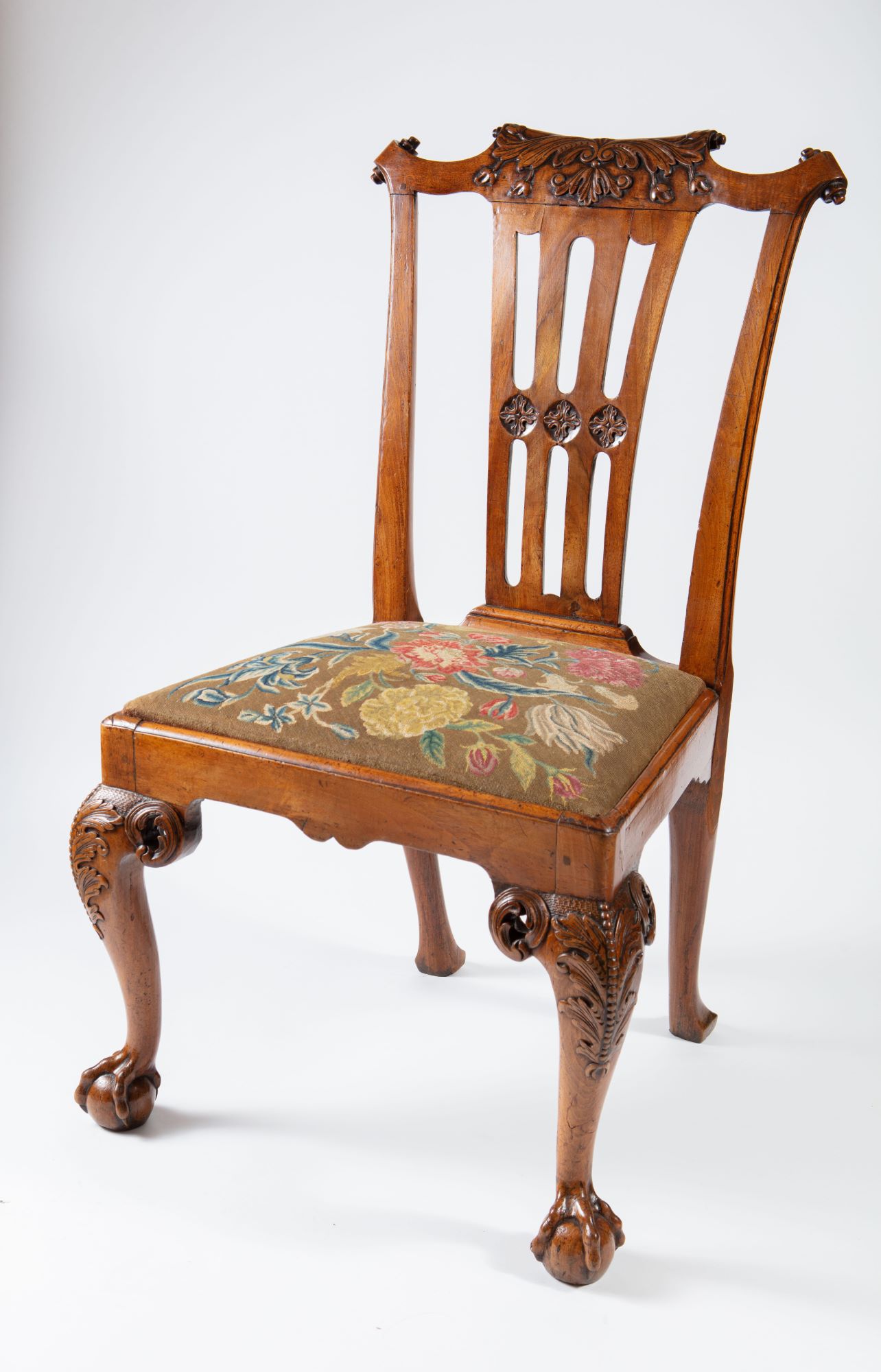
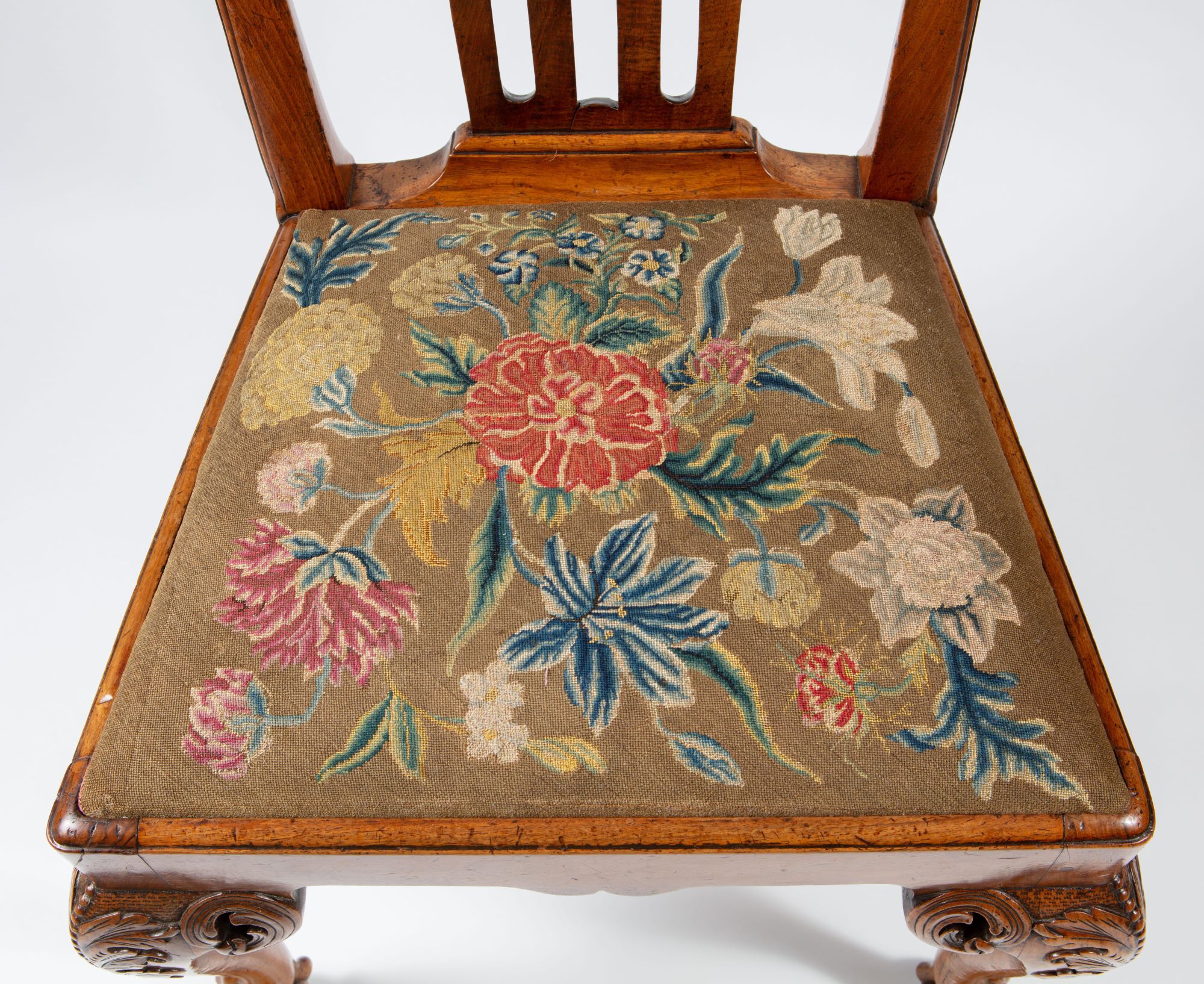
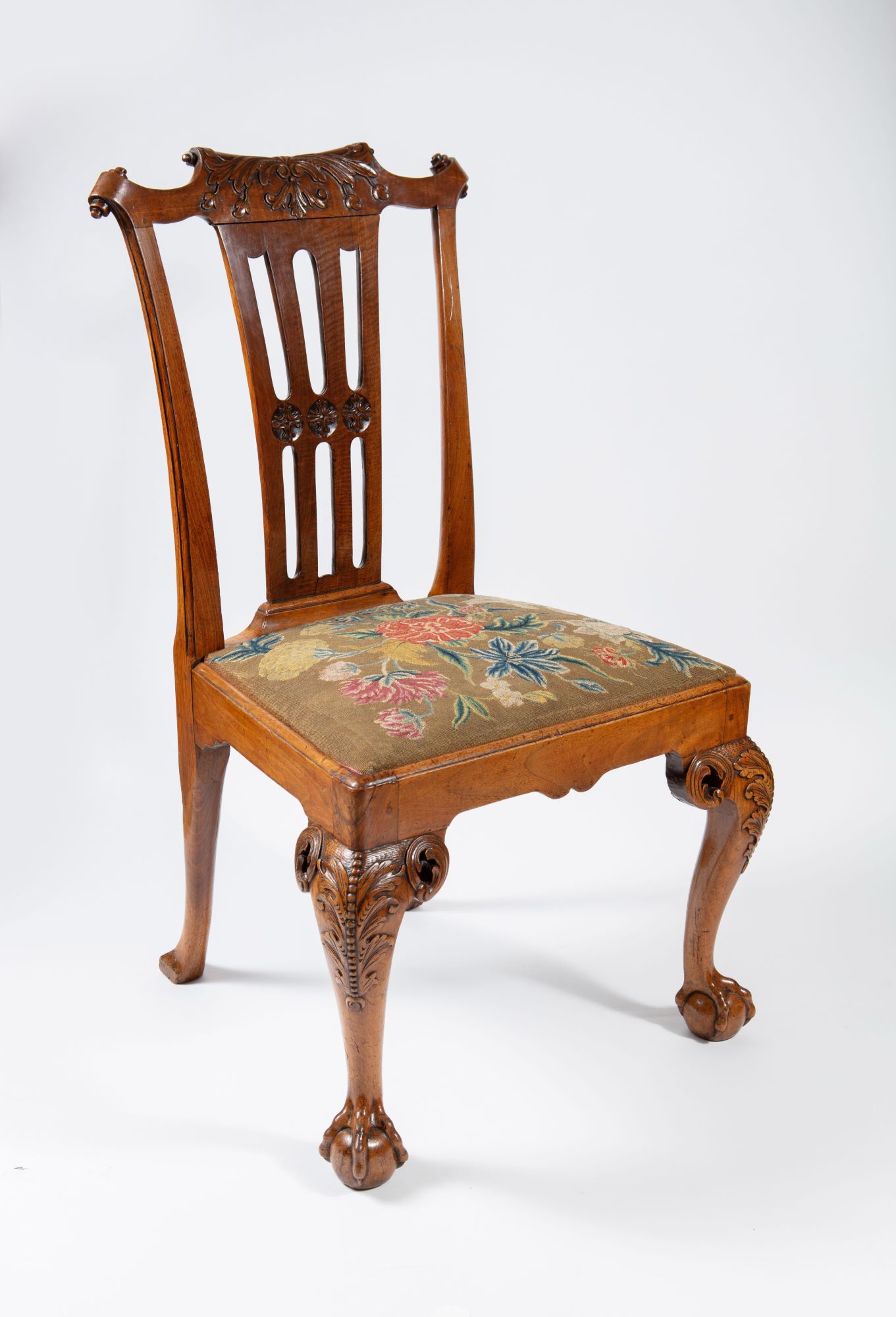
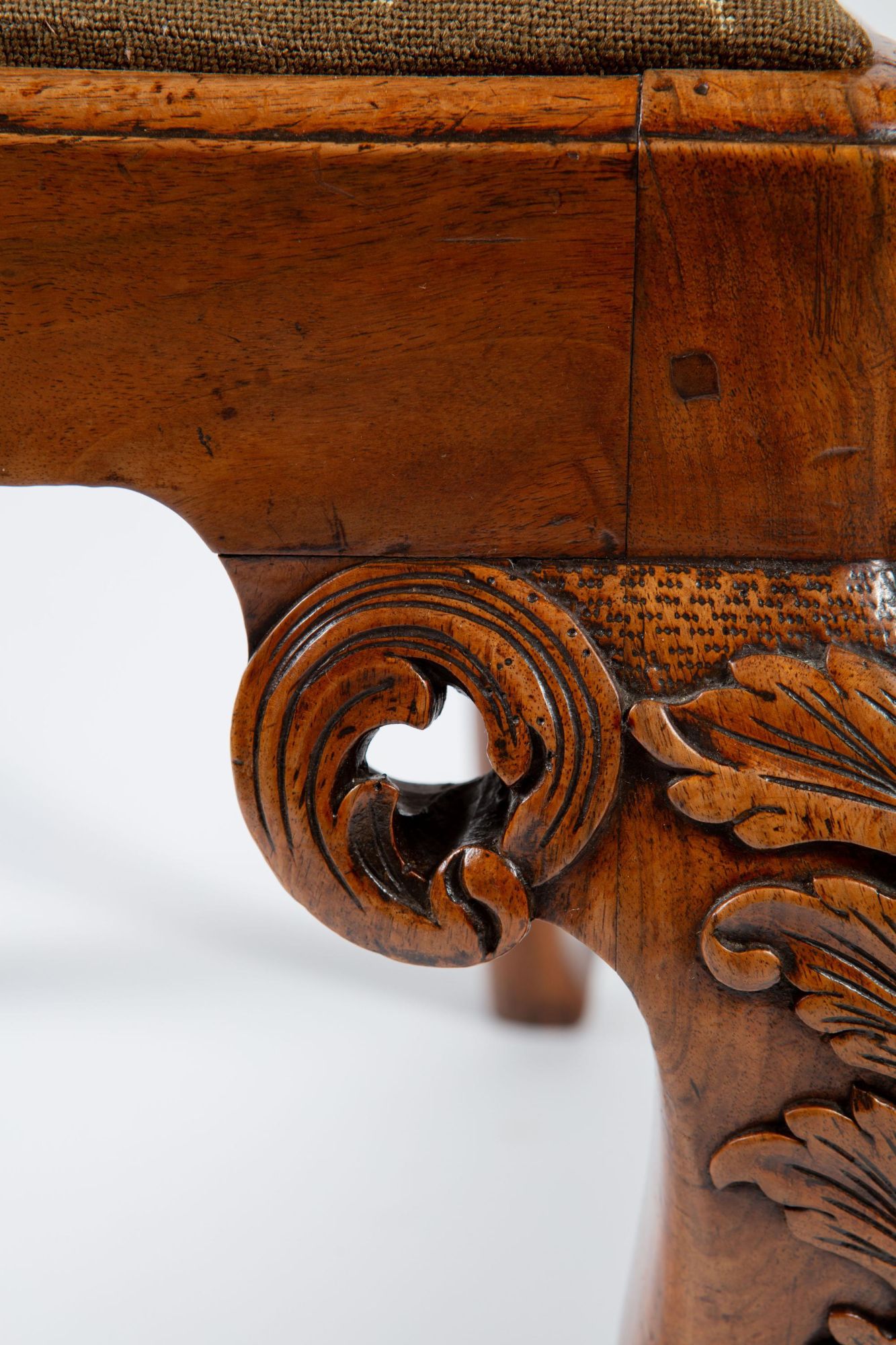
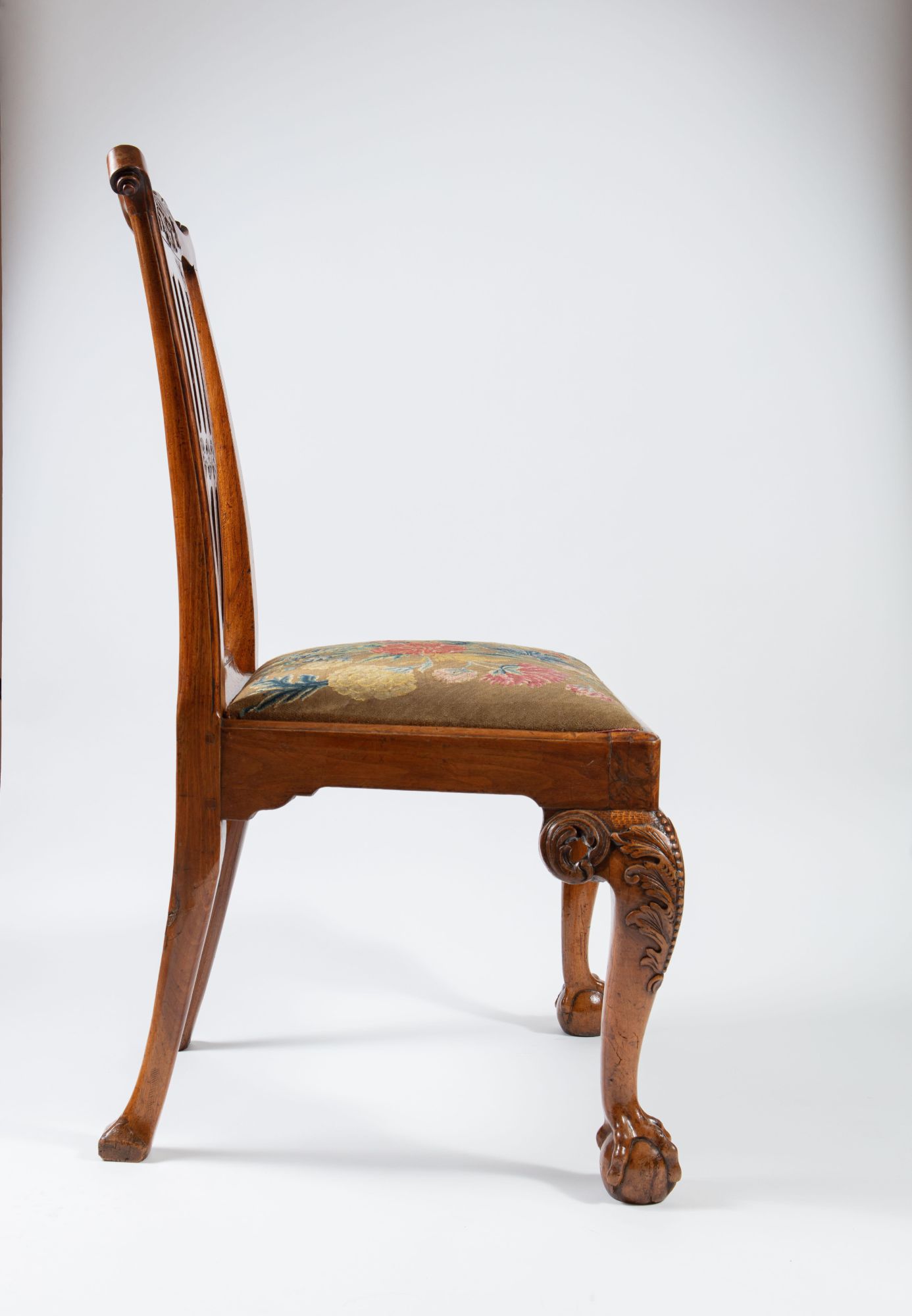
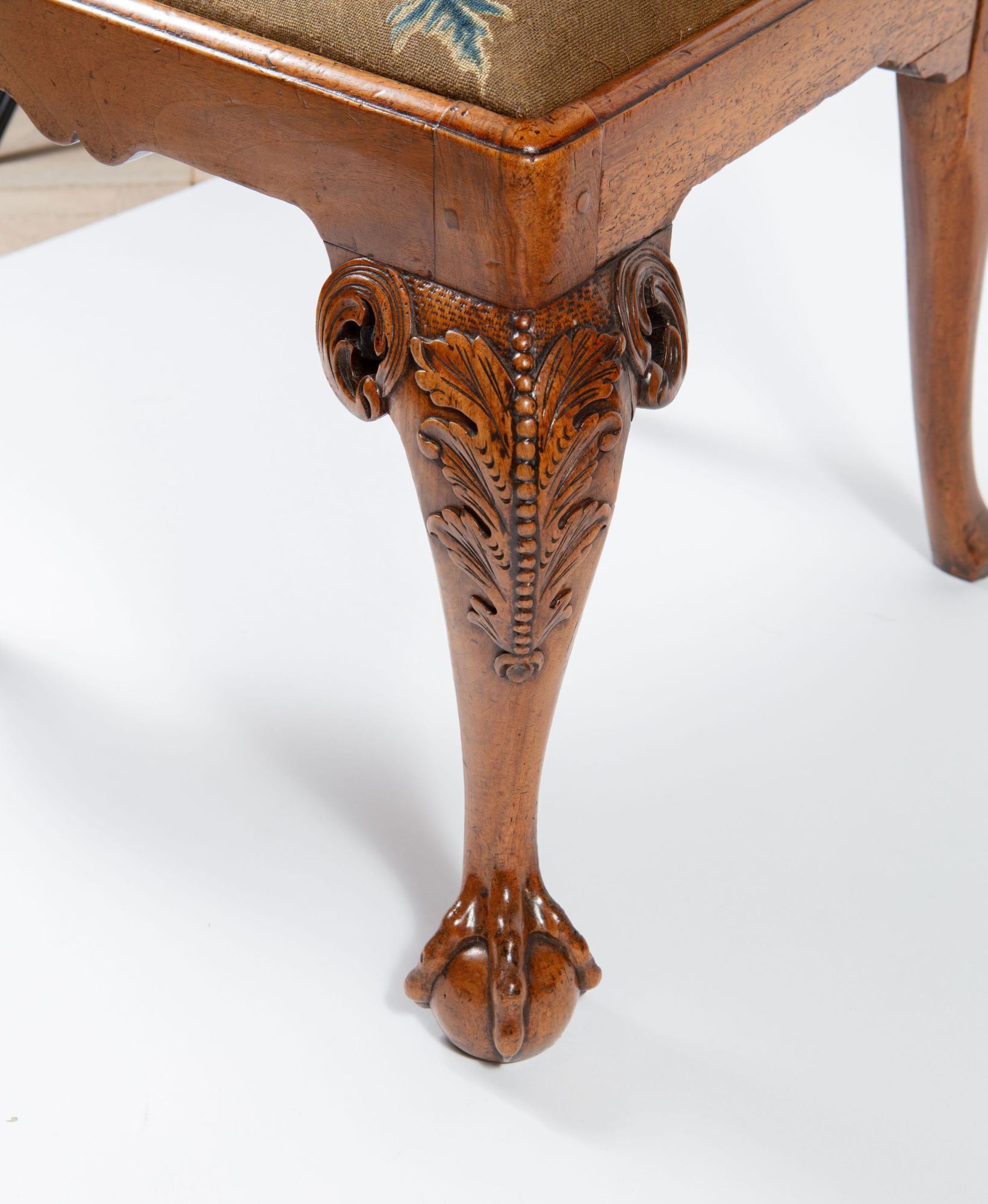
A pair of Irish George II walnut side chairs, the splayed backs with double scroll top rail carved with acanthus decoration, with three carved foliate motifs linking the vertical bars of the splat, the drop-in seats covered in fine mid 18th century petit point needlework decorated with flowers on a hazel-coloured ground, the plain seat rail on boldly carved front cabriole legs with acanthus leaf and a vertical string of pearls flanked by pierced scrollwork ears, on ball-and-claw feet and swept back shaped legs.
These exquisitely carved walnut side chairs exemplify Irish mid‑18th century craftsmanship, reinterpreting with a markedly more sculptural and expressive vocabulary, models of chairs produced in London during the same period. The chair's overall profile comprising a shaped top‑rail, pierced foliate splat and acanthus‑carved cabriole legs terminating in claw‑and‑ball feet, corresponds closely to the Irish George II tradition documented in both urban and provincial workshops during the period.
The top‑rail, carved with a stylised floral cresting, demonstrates the Irish preference for bold, rounded relief carving rather than the flatter, more linear treatment typical of English makers. Below, the splat is pierced and carved with interlaced foliate motifs, a pattern that appears in several Irish sets of the mid‑18th century and reflects the local enthusiasm for organic, almost Baroque forms. This approach diverges from the more geometric or strapwork‑based splats seen in London examples, underscoring the autonomy of Irish design even when drawing from designers such as Thomas Chippendale.
The front legs, carved with deep acanthus leaves on the knees, descend into robust claw‑and‑ball feet of a type strongly associated with Irish production. Irish feet of this period are typically more bulbous and assertive than their English counterparts, with pronounced talons and a rounded ball; the present examples conform to this typology. The rear legs, raked and shaped, further support an Irish attribution, as their stance and weight differ from the more restrained English pattern.
Comparable chairs appear in Irish country house collections, including Malahide Castle and Leixlip Castle, and in documented sets sold through Christie's and Adam's of Dublin. The Knight of Glin and Peill illustrate related examples in their seminal publication, Irish Furniture (2007), noting the characteristic Irish tendency toward "a more exuberant and sculptural interpretation of Chippendale's designs." ¹ The present chair aligns closely with this description, combining Chippendale‑derived structure with carving that is unmistakably Irish in spirit.
The chairs represent well‑preserved examples of mid‑century Irish craftsmanship and contribute to the broader understanding of regional variations within the Chippendale tradition.
The drop‑in seats are covered in exceptionally fine English petit point needlework, executed with a stitch density and chromatic subtlety characteristic of mid‑18th‑century domestic embroidery at its highest level. Petit point, worked at a markedly higher stitch count than gros point or tent stitch, permits the rendering of motifs with painterly precision and the present covers demonstrate this capacity through their delicately shaded floral sprays, scrolling foliage and balanced asymmetry.
The rococo idiom of the design is unmistakable. The bouquets are arranged in loose, naturalistic clusters, with soft transitions between hues that evoke the watercolour palette fashionable in English embroidery between the 1740s and 1760s. The motifs correspond closely to patterns found in mid‑century English embroidery manuals and pattern books, which encouraged the depiction of flowers in a more spontaneous, asymmetrical manner than the rigidly organised Baroque schemes of the earlier Georgian period. The shading of petals and leaves, achieved through incremental changes in thread colour rather than abrupt contrasts, reflects the technical sophistication of the embroiderer and aligns with the broader movement toward naturalism in the English decorative arts.
The survival of such fine petit point on drop‑in frames is noteworthy. Drop‑in seats were designed for ease of removal and reupholstery, and as a result, original or early needlework covers are often lost. The present examples retain their period character and exhibit the gentle wear consistent with 18th‑century domestic use. In the context of the chair, the needlework contributes significantly to the object's interpretive richness. It demonstrates that the seat furniture was valued enough to receive costly and time‑intensive embroidery, and it situates the chair within a domestic environment where textile artistry was both cultivated and displayed.
Footnotes
1. Knight of Glin & James Peill, Irish Furniture, Yale University Press, 2007, esp. pp. 142-155, where comparable splat patterns and acanthus‑carved cabriole legs are illustrated.
2. For related Irish mahogany chairs with ball-and-claw feet, see Christie's, London, Important English Furniture, 22nd January 2009, lot 118 and Christie's, New York, the Collection of Frank Cozer Knowles, 22nd October 1988, lot 236. Also Adam's, Dublin, Irish Furniture sales.
3. On the adoption of mahogany in Irish workshops, see Cescinsky, English Furniture of the Eighteenth Century, 1910, for comparative English prototypes and divergences.
4. For Irish carving characteristics, including the distinctive modelling of claw‑and‑ball feet, see James Peill, "Irish Furniture: Regional Characteristics," Furniture History, Vol. 43 (2007).
Dimensions:
circa 1740
Ireland
RELATED ITEMS




, noting the characteristic Irish tendency toward "a more exuberant and sculptural interpretation of Chippendale's designs." ¹ The present chair aligns closely with this description, combining Chippendale‑derived structure with carving that is unmistakably Irish in spirit.The chairs represent well‑preserved examples of mid‑century Irish craftsmanship and contribute to the broader understanding of regional variations within the Chippendale tradition.The drop‑in seats are covered in exceptionally fine English petit point needlework, executed with a stitch density and chromatic subtlety characteristic of mid‑18th‑century domestic embroidery at its highest level. Petit point, worked at a markedly higher stitch count than gros point or tent stitch, permits the rendering of motifs with painterly precision and the present covers demonstrate this capacity through their delicately shaded floral sprays, scrolling foliage and balanced asymmetry. The rococo idiom of the design is unmistakable. The bouquets are arranged in loose, naturalistic clusters, with soft transitions between hues that evoke the watercolour palette fashionable in English embroidery between the 1740s and 1760s. The motifs correspond closely to patterns found in mid‑century English embroidery manuals and pattern books, which encouraged the depiction of flowers in a more spontaneous, asymmetrical manner than the rigidly organised Baroque schemes of the earlier Georgian period. The shading of petals and leaves, achieved through incremental changes in thread colour rather than abrupt contrasts, reflects the technical sophistication of the embroiderer and aligns with the broader movement toward naturalism in the English decorative arts.The survival of such fine petit point on drop‑in frames is noteworthy. Drop‑in seats were designed for ease of removal and reupholstery, and as a result, original or early needlework covers are often lost. The present examples retain their period character and exhibit the gentle wear consistent with 18th‑century domestic use. In the context of the chair, the needlework contributes significantly to the object's interpretive richness. It demonstrates that the seat furniture was valued enough to receive costly and time‑intensive embroidery, and it situates the chair within a domestic environment where textile artistry was both cultivated and displayed. Footnotes1.	Knight of Glin & James Peill, Irish Furniture, Yale University Press, 2007, esp. pp. 142-155, where comparable splat patterns and acanthus‑carved cabriole legs are illustrated.2.	For related Irish mahogany chairs with ball-and-claw feet, see Christie's, London, Important English Furniture, 22nd January 2009, lot 118 and Christie's, New York, the Collection of Frank Cozer Knowles, 22nd October 1988, lot 236. Also Adam's, Dublin, Irish Furniture sales.3.	On the adoption of mahogany in Irish workshops, see Cescinsky, English Furniture of the Eighteenth Century, 1910, for comparative English prototypes and divergences.4.	For Irish carving characteristics, including the distinctive modelling of claw‑and‑ball feet, see James Peill, "Irish Furniture: Regional Characteristics," Furniture History, Vol. 43 (2007).)